Blog
Mapping the Deadverse: Worldbuilding and Narrative in the Lyrics of the Grateful Dead
In February I attended the Grateful Dead Studies Association Conference in Albuquerque. As I prepare to put together my next submission I figure it's probably time to update this site a little and share that presentation, so please, enjoy:
In 1901 William James took to the podium in Edinburgh to present his lectures on the Varieties of Religious Experience. Before he started he noted that as an American he was used to listening while Europeans spoke, and that he felt a certain trepidation to turn the tables. A hundred and twenty five years later they’re trepidatiously turned again as I take the podium here. As a European I’m much more accustomed to listening to Americans talk about the Grateful Dead than I am to deliver lectures of my own but, like William James, I hope this marks the beginning of larger cross-atlantic collaboration, and more audaciously perhaps, avenues of study. My presentation today is an overview of my PhD Thesis titled Mapping the Deadverse: Worldbuilding and Narrative in the Grateful Dead. For the last three years I’ve been undertaking a research project that hopes to cast the Grateful Dead’s songbook as an early experiment in transmedia worldbuilding.
It is first important to discuss what is meant by "worldbuilding" , and why it matters that the Grateful Dead were involved in it. Simply, worldbuilding is a process of developing a unified and cohesive fictional world, often across a number of different mediums and narratives. This is something that has happened naturally for thousands of years, but has become a far larger part of our culture over the back end of the 20th century with the expansion of projects like Lord of the Rings and Star Wars. More recently media conglomerates have picked up on the financial potential of this storytelling trend. We have reached a point where transmedia storytelling is incredibly common. Mark J.P. Wolf is a powerful voice in worldbuilding study, and in his foundational Building Imaginary Worlds he writes:
An experienced screenwriter told me, “When I first started, you would pitch a story because without a good story, you didn’t really have a film. Later, once sequels started to take off, you pitched a character because a good character could support multiple stories. And now, you pitch a world because a world can support multiple characters and multiple stories across multiple media.” (1)
Wolf was writing in 2014, two years after The Walt Disney Company acquired Lucasfilm and consequently the rights to the Star Wars universe. In the decade or so hence they have expanded the universe at an unprecedented rate. There have been five movies and over ten series, live action and animated, as well as theme park zones and video games. In a 2024 shareholder presentation it was revealed that the Star Wars franchise had made a 2.9x return on investment for the company, putting it behind original intellectual property like Toy Story or Frozen but still offering very impressive figures. Worldbuilding today is big business. (2)
This was not so much the case when the Dead began their worldbuilding project. In a posthumous letter to Jerry Garicia, the band’s lyricist Robert Hunter wrote:
Walking down Madrone Canyon in Larkspur in 1969, you said some pretty mindblowing stuff, how we were creating a universe and I was responsible for the verbal half of it. I said maybe, but it was your way with music and a guitar that was pulling it off. (3)
This highlights the conscious nature of the project, and sets the clear goal of creating a lyrical and musical universe. Marta Boni in her introduction to World Building writes that “a world cannot be interpreted as the mere sum of individual media bricks, but instead as a life form, determined by a set of texts and their interpretations, superimposed over the years.” There is a temporal element to worldbuilding, offering fans a sense of growth. The stories and the world grow alongside them, with the ideas and philosophies explored offering support and guidance. Deadheads have an important role, both in their relationship with the band, and the building of the universe. One only needs to look at “Keep your Day Job” to know that the fans had a clear say in this worldbuilding effort. They act as vital partners, and this collaboration flows both ways. The Dead’s universe has made a palpable influence on the tapestry of America today through the evangelising and creative endeavours of fans. Whether this manifests in hundreds of Dead related business names, or influence on the top echelons of politicians like Nancy Pelosi, there are tangible impacts that stem from the band’s worldbuilding.
I have broken my exploration of the band’s construction of this universe into five central pillars. Given the specialist nature of this audience, I will pass over them quickly, and leave the gaps to your imagination, saving laborious explanations for when I present this in Glasgow in a couple of months, as I’m keen to dig into some slightly heavier ideas here.
In Chapter 1, I explore what I consider to be the basis of the Grateful Dead’s universe, and how fans will first interact with it. This is through the characters. I use Bakhtin’s concept of heteroglossia to help explore the effect of these contrasting and nuanced voices.
In Chapter 2, I explore how the band uses folk songs and cover songs to fill out their original universe and examine the influence of the folk mode on their approach to music. I also demonstrate that these covers and folk songs, through their inclusion in the live experience, become a part of the band’s worldbuilding. This not only expands the possible combinations of songs and explorations of themes, but tethers the band’s fictional universe to our own. It adds a sense of authenticity to the universe with original songs that explore historical modes appearing genuine.
Chapter 3 explores the band’s connection to the Beat generation, and the influence that the road lifestyle had on the band and their fans. I explore the role of the Merry Pranksters and Neal Cassady. These elements of the band’s universe are central to understanding the sense of adventure and the drive for novelty that preoccupied both sets of artists, while the key influence of Cassady helps to create a bridge between this 50s literary movement and the hippies.
Chapter 4 explores the use of perspective and reference throughout the band’s catalogue. I compare the construction of their universe to William Blake’s, in poems like Jerusalem, and seek to understand how the use of varied perspectives can lead closer to a central truth. I then explore the influence of Herman Hesse’s Glass Bead Game, which Hunter identified as a key part of his worldbuilding process.
The final chapter will explore the spiritual nature of this experience, connecting it to historical examples such as the Mysteries of Eleusis, and seeking to understand what influence this has on the band’s universe.
With the time I have left I want to dig into the idea of the Grateful Dead universe as a Glass Bead Game. Throughout the thesis I’ve been constantly exploring the significance of Hunter and the wider band’s use of reference, and as I was digging through his online mailbag I found a letter that made everything fall into place:
In my early twenties I was struck with Hesse’s image of the Glass Bead Game in ‘Magister Ludi.’ I decided to play it. The upshot is that what people can't readily understand in my work has been written off as hippy dippy tripping. ‘Eyes of the World’ is a good example. - a young song about resolution of the subject-object conflict with overtones of Santayana. (4)
We see here Hunter suggesting that the depth of some of his lyrics were lost on general audiences, and gesturing towards the deeper levels of meaning and understanding possible through a wide ranging cultural study. “Eyes of the World” references Satayana only in terms of ideas. There are multiple levels then on which references occur: Lyrically, musically and philosophically. The Glass Bead Game is a novel by Hermann Hesse that deals with themes of academia and knowledge by presenting a society that has centralised itself around these values. The most well rounded and intelligent pupils are promoted to elite schools that train them in a wide range of subjects, and teach the “Castalian” way of life that foregoes the individual and prioritises a scholarly hierarchy. If they make it through the rigorous schooling they become a kind of scholarly priest. Members of Castilia commit to a monastic lifestyle, rejecting property and marriage, and living simply. Throughout this society runs the Glass Bead Game, the literal mechanics of which are not mentioned, but which is a complex game that seeks to turn culture and knowledge into symbols and then use those symbols to explore the hidden harmonies in varying perspectives.
At the outset of the novel we have a general introduction that begins the worldbuilding of this strange society and gives us an outline of the way the game functions:
The only way to learn the rules of this game of games is to take the usual prescribed course, which requires many years; and none of the initiates could ever have any possible interest in making these rules easier to learn. These rules, the sign language and grammar of the Game, constitute a kind of highly developed secret language drawing upon several sciences and arts, but especially mathematics and music (and/or musicology), and capable of expressing and establishing interrelationships between content and conclusions of nearly all scholarly disciplines. The Glass Bead Game is thus a mode of playing with the total contents and values of our culture; it plays with them as, say, in the great age of arts a painter might have played with the colors on his palate. All the insights, noble thoughts, and works of art that the human race has produced in its creative eras, all that subsequent periods of scholarly study have reduced to concepts and converted into intellectual property - on all this immense body of intellectual values the Glass Bead Game player plays like an organist on an organ. (5)
Music represents the foundation of the Game, and is the protagonist's first talent. It is also where the Game has its origins, with the glass beads used to represent musical notation in the game’s infancy. The protagonist is chosen at a young age to join the elite rank of schools due to his prodigious musical talent via a meeting with the Music Master, where the two play together:
They played the song many times, and with each repetition the song was involuntarily enriched with embellishments and variations. The bare room resounded festively in the cheerful light of the forenoon…The Master chimed in gaily with his three voices, and the four parts drew their thin, lucid lines, spoke to one another, mutually supported, crossed, and wove around one another in delightful windings and figurations. The boy and the old man ceased to think of anything else; they surrendered themselves to the lovely, congenial lines and figurations they formed as their parts crisscrossed. Caught in the network their music was creating, they swayed gently along with it, obeying an unseen conductor…he saw the whole cosmos, guided, ordered, and interpreted by the spirit of music. (7)
This could well be a description of the Grateful Dead concert experience. The improvisational and dialectic nature of the music combined with a sense of the creative source define both approaches to performance. It’s not just Hunter’s work that is illuminated by applying this work, but the entire band’s approach to art in general. The audience isn’t engaging with Hunter alone, but Hunter and the band are playing the game as well, with the musical parts embellishing and responding to the thematic landscape explored via the lyrics. Just as Hunter makes reference, so too does the band. This happens not only through their use of covers but also through the recreation and amalgamation of musical ideas that originated in jams, or through the use of literal short music references. This can be seen in jams like “Spanish Jam” which is based on Miles Davies’ “Solea”, or in reference to cultural phenomenon, like “Close Encounters Jam”. The idea of music as a form of communication, full of encoded dialectic possibilities, also connects back to the Glass Bead Game itself, and the band’s philosophy of music. This is explored thematically in both Close Encounters of the Third Kind and the band’s sonic elaborations on the theme. (8)
The Glass Bead Game seeks to create a total game that uses the academic productions of humanity to create ludic constructions of deep themes. The most artful players of the game seek to show the unity of disparate ideas, as put by the Music Master to the young protagonist: “never forget what I have told you so often: our mission is to recognise contraries for what they are: first of all as contraries, but then as opposite poles of a unity. Such is the Glass Bead Game.” The child grapples with this difficulty, not just in the game but in life itself, saying: "everything is contradictory, everything is tangential; there are no certainties anywhere. Everything can be interpreted one way and then again interpreted in the opposite sense.” (9)
This is, I’m sure, how myself and many other academics feel trying to pin down some of the band’s more esoteric lyrics.
In a lot of ways The Glass Bead Game precedes Roland Barthe’s semiotic and cultural understanding of myths explored in Myth Today. The theorist uses an example of a magazine cover showing a photo of a young black soldier saluting the French flag:
I see very well what it signifies to me: that France is a great empire, that all her sons, without any colour discrimination, faithfully serve under her flag, and that there is no better answer to the detractors of an alleged colonialism than the zeal shown by this [young man] in serving his so called oppressors. I am therefore faced again with a greater semiological system: There is a signifier, itself already formed with a previous system (a black soldier giving the French salute); there is a signified (it is here a purposeful mixture of Frenchness and militariness); finally there is a presence of a signified through the signifier. (10)
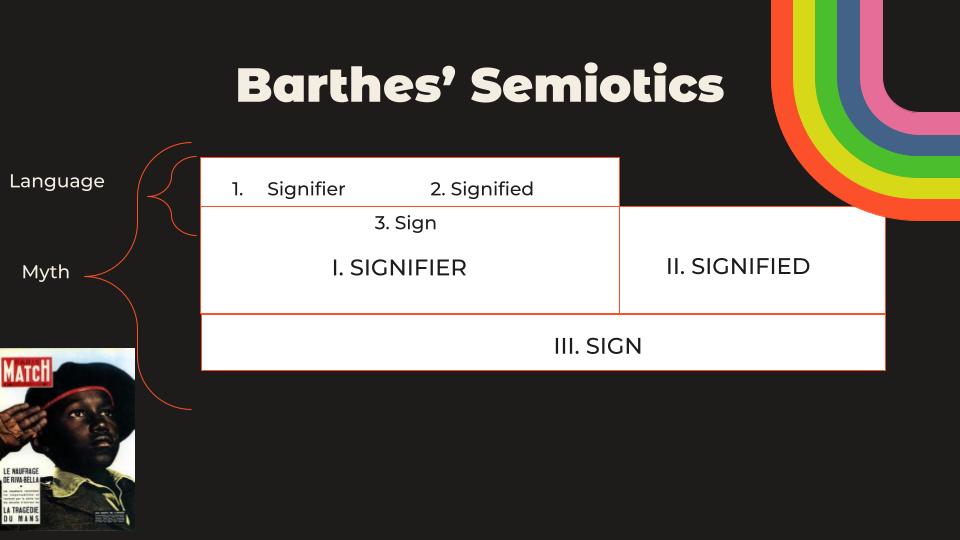
Just as in the Glass Bead Game elements of society and culture are reduced to signifiers themselves, and used as building blocks to construct new narratives. Thus we can see the mythological function of the Glass Bead Game as well as its clearly semiotic nature. Both Barthes and Hesse seek to show how meaning compounds over time as well as how art and culture build on that which came before them. Hesse’s work is less outwardly political than Barthes’, but both travel in the same direction. The Grateful Dead’s folk inspired worldbuilding also seeks to show this interplay of meaning. In this example I used Hunter’s application of “The Lady of Carlisle” in the first section of Terrapin, where a folk song about love, commitment, and bravado is repurposed to explore narrative as a means of spiritual development.

The Dead’s lyricists fill their lyrics with symbol and reference in order to create an interactive worldbuilding that leads listeners on educational journeys of research, while conveying thematic narratives in a variety of perspectives. Not only do the songs contain multiple readings, but there are pairs or collections of songs that explore the same theme or event from different angles. This can be seen when comparing the Hunter/Weir song “Playin’ in the Band”, and the Barlow/Weir song “The Music Never Stopped”. I suggest that these two songs can only be fully understood in tandem. “Playing in the Band” is a song that explores the responsibilities of the rarified status the band held, telling listeners that “when it’s done and over/ a man is just a man”. The line “Standing on a tower/world at my command” gestures towards Jesus atop the temple being tempted to test his divinity, and highlights the weight of responsibility placed on the band. This is the opposite perspective to “The Music Never Stopped", which explores a concert from the perspective of an entranced audience member. (11, 12)
These songs are not just connected by their concert focus, and spiritual viewpoints, but through images in the songs as well. The protagonist of “Playing in the Band” says “You just keep a’ turning/While I’m playing in the band”, while in “The Music Never Stopped” we see the same image from a lower perspective: “The stars were spinning dizzy”. Both of these images connect to the spinners, creating bridges that connect the fictional and the real while also establishing intertextual links.
Both stories here contain traces of the other’s complications too, recalling the drops in the yin and yang symbol. While “Playing in the Band” deals with this weight and responsibility, it also revels in the joy of performing music for adoring fans. This is shown by lines like “I don’t trust in nothing, but I know it come out right”, or the chorus which again references reality and the times that the Dead played all night. In the case of “The Music Never Stopped” there is a slight and subtle volta at the end of the song that under analysis offers a startling change. The song starts beside a river, with a reference to George Gershwin’s “Summertime”, as we hear that the “Fish are rising up like birds”.
We can begin to see the way in which the band’s Glass Bead Game functions, with references being used to contribute to worldbuilding in meaningful ways. The fish are jumping, and one imagines the cotton high, or perhaps Gershwin’s “Summertime” itself on the breeze. Some references stand out like this, acting as a hook, but not all of them are so obvious. There are gradually deepening analytical pathways that lead listeners on an internal journey of understanding.
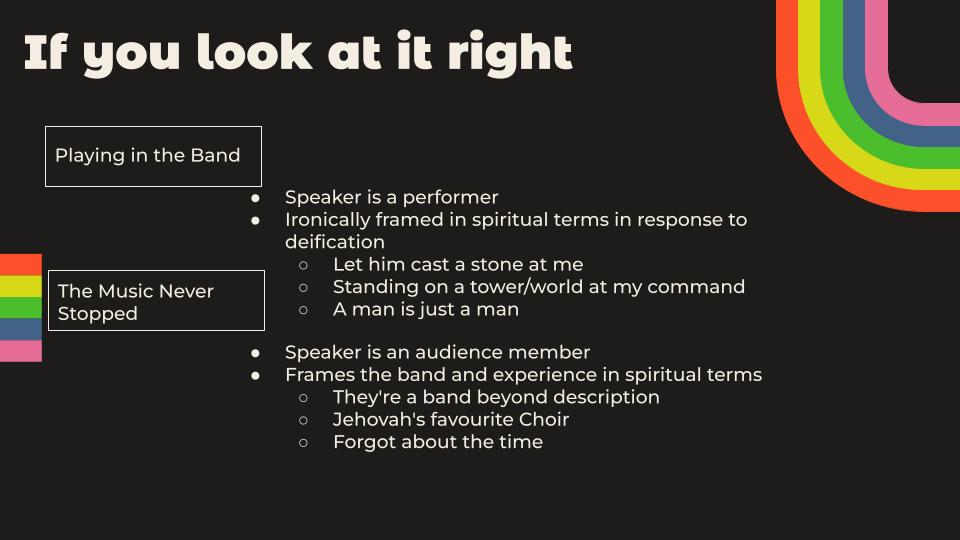
This song, much like “Playing in the Band”, contains many references that connect directly to the band’s live experience. “There’s a band out on the highway” connects to the way the band spent much of the year travelling and touring, while “it's a rainbow full of sound” typifies a psychedelic synesthesia connecting to the band’s Acid Test roots. The song is full of the joy of the carnival, with “fireworks, calliopes and clowns”, but behind this there is a sense of danger that I think is underadressed.
The audience are so wrapped up in the show that they don’t even realise when it finishes, and become unable to distinguish between the band’s absence and its presence. This is the first sense that something is wrong. “A cool breeze came on Tuesday”. Summer is over, living should perhaps be a little less easy. The heat has broken, the harvest is high. The fields are full of people but they’re not working; they’re dancing. The music never stopped. This image recalls European “dancing plagues” which are often attributed to ergotamine poisoning. The poisoning is caused by a grain blight making its way into bread products, and this blight contains an LSD precursor, highlighting another psychedelic connection. No matter how transcendent the music is, it must stop, if only so that we can understand what its presence really means.
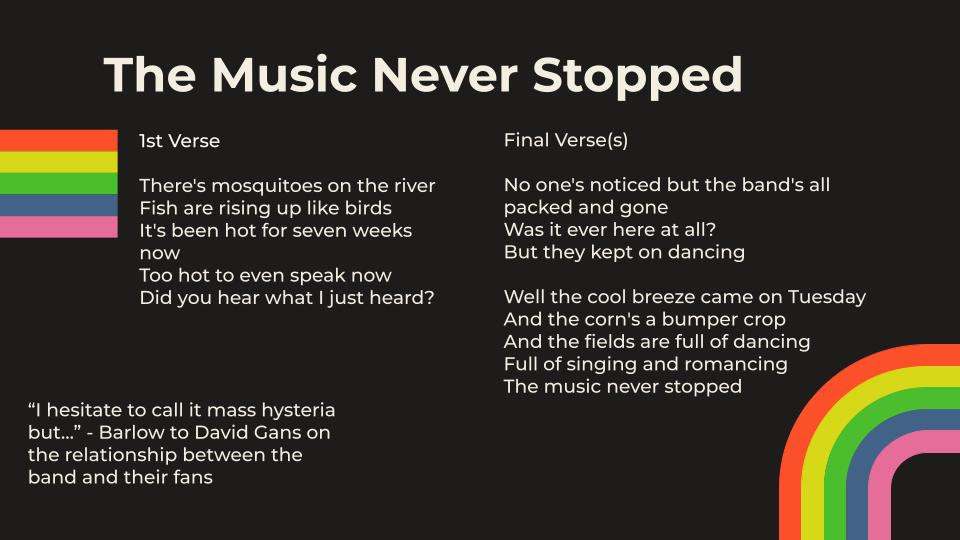
Of course, an opposite reading is also possible, wherein the workers are doing their duty in their fields having carried forward the spirit of unbridled joy that they learned from the show, and the singing and the dancing is a supplement to the work. This again is something that will change based on the context you find yourself in, but the volta is fairly clearly marked in the text, with the temporal and seasonal change not being followed by appropriate behaviour. Barlow commonly explores the undercurrent of danger that ran through the Dead scene, with its nomadic lifestyle, heavy association with drugs, and proximity with characters like the Hell’s Angels.
Both songs then convey that while the event is a joyous and even spiritual time, one should be wary of grabbing too hard. Another instance of this duality of perspective can be seen in the band's exploration of Western narratives, particularly undertaken by Barlow and Weir. The band frequently covered Marty Robbin’s “El Paso” which tells a romantic story of a cowboy who murders for love, which can be compared directly with the Barlow lyric “Mexicali Blues”. The latter protagonist strips away the rose-tinted spectacles of the former, and presents a character who is leeringly violent.
Both are on the run in border towns, living on the edge of both the law and the United States as a whole, but the contrast in how the two characters are framed is stark. The sneering depravity of the Mexicali cowboy is laid out in rank detail. These two songs come together, along with a number of others in the catalogue, to create a Glass Bead Game around the concept of the cowboy in American culture. The family of the man killed in “El Paso” will see its protagonist in a light that is more accurately portrayed in “Mexicali Blues”, showcasing the importance of context and perspective while exploring these narratives. Hesse’s novel itself is an exploration of the ways in which the artist/observer dichotomy functions, with the game being the way in which all art is created; that is the application, reception, and reply of symbol and reference to create something new with contemporary meaning. The most well established and enduring works then become fodder for symbolisation themselves.
There is a particularly spiritual power to this process that was proclaimed in a letter from the Vatican under Pope Francis. He explores the spiritual benefits of picking up a wide variety of perspectives and experiences through fiction, and the role of literature in formation. Pope Francis notes the same thing that the characters of “Terrapin Station” realise when they find themselves changed and challenged by that narrative:
It is clear, then, that the reader is not simply the recipient of an edifying message, but a person challenged to press forward on a shifting terrain where the boundaries between salvation and perdition are not a priori obvious and distinct. Reading, as an act of “discernment”, directly involves the reader as both the “subject” who reads and as the “object” of what is being read. In reading a novel or a work of poetry, the reader actually experiences “being read” by the words that he or she is reading. (13)
This is what the Storyteller conveys to the audience in “Terrapin Station” when he says “you decide if he was wise”. As we’ve seen the “Lady with a Fan” section of the suite explores how reference works in the folk mode as well. There is a distinct spiritual power in participating in the construction of fictional worlds. The varied perspectives and voices help expand our concept of the real and the possible. Hunter’s application of reference first makes people engage with his influences, then apply their own in response. One can’t be sure if a reference was intended or imagined and that ambiguity encourages engagement. Fans add their own references and understandings to open lyrics, that then become more deeply interconnected with the listener's life.

Hunter’s writing style consciously tries to make itself porous, and centres the relationship between the listener and the artist in a way that is typical of the wider Dead. The Grateful Dead’s lyrics play an important role in fans' interaction with the music. In a band focused on improvisation and change, there are remarkably few instances of changes to lyrics happening. Weir altered the “Looks like Rain” lyrics briefly, but it didn’t stick. This is because the lyrics are fans' main highway into the Deadverse, and significant lyrical changes threaten the audience's ability to participate in the concert experience. Bobby’s occasional lyrical jokes are one thing, but serious alterations to the architecture of songs would affect the solidity of the universe.
I don’t need to explain to Deadhead’s the feeling of being immersed in this universe, how it enters your life, or the stature it comes to take on. I’ve set out to try and understand why this strange American band has captured so many years of my life, why my relationship to this music is different to all the other artists I love, and what sets the Dead apart. The richness, depth, and interactive nature of their worldbuilding is central.
I will leave you will a Glass Bead Game quote that I think speaks to the Deadhead experience, and hopefully ties this all up a little:
I suddenly realised that in the language, or at any rate the spirit of the game, everything was all-meaningful, that every symbol or combination of symbols led not hither and yon, not to single examples, experiments, and proofs, but into the center, the mystery and innermost heart of the world, into primal knowledge. Every transition from major to minor in a sonata, every transformation of myth or a religious cult, every classical or artistic formulation was, I realized in that flashing moment, if seen with a truly meditative mind, nothing but a direct route into the interior of the cosmic mystery, where in the alternation between inhaling and exhaling, between heaven and earth, between Yin and Yang, holiness is being created. (14)
Thank you
(1) Mark J.P. Wolf, Building Imaginary Worlds. 1st edition. New York: Routledge, 2014.
(2) The Walt Disney Company, “The Right Board, the Right Strategy: Disney’s Plan for Shareholder Value Creation”, March 2024 https://www.sec.gov/Archives/edgar/data/1744489/000095015724000366/defa14a.htm
(3) Robert Hunter, Letter to Jerry Garcia, August 1996 https://archive.org/post/319162/hunters-letter-to-jerry-revisited-thanks-bd
(4) Robert Hunter, Letter to Alan Moses, October 3rd 1996 https://web.archive.org/web/20080720084035/http://www.hunterarchive.com/files/mailpages/mailbag10.17.96.html (Accessed via wayback machine, website no longer extant); Original link; http://www.hunterarchive.com/files/mailpages/mailbag10.17.96.html
(5, 6, 7) Herman Hesse, trans Richard Winston, Clara Winston, The Glass Bead Game (London: Vintage) 2000, p.6, pp.22-23, pp. 46-47
(8) First reference to Close Encounters of the Third Kind is 29/12/1977, which features the five note riff that the aliens play to attempt communication with the humans, but the jam is extended on 22/01/1978. It is played under ten times total, but another interesting rendition is 15/07/1989 in Indiana, close to where the UFOs are first seen in the movie, drawing connections between fiction and reality.
(9) Glass Bead Game, pp. 72-72
(10) Roland Barthes, trans. Annette Lavers, Mythologies (Vintage: 2009) p.139
(11) Matthew 4:5-9; Luke 4:9-12
(12) Grateful Dead, “Playin’ in the Band” track 4 on Skulls and Roses (Warner Bros: 1971) vinyl; Grateful Dead, “The Music Never Stopped” track 6 on Blues for Allah (Grateful Dead Records: 1975) vinyl
(13) Pope Francis, “Letter of his Holiness Pope Francis on the Role of Literature in Formation”, 17/07/24 https://www.vatican.va/content/francesco/en/letters/2024/documents/20240717-lettera-ruolo-letteratura-formazione.html
(14) Glass Bead Game pp. 108-109